Browse by Type
|
Cabaran penjaja kecil wanita dalam era pandemik covid- 19 di Perlis
Item Type: Article
Editor:
Year: 00/12/2021
Abstract: Conventional business norms are now drastically changing with the outbreak of the unprecedented covid-19 pandemic. Thus, this study examines the challenges of small hawkers in the era of the Covid-19 pandemic in Perlis. The study respondents consisted of 200 small women hawkers around small towns in Perlis.
|
|
|
|
|

|
Memperkasakan keusahawan sosial produk menstruasi bagi membasmi kemiskinan haid
Item Type: Article
Editor:
Year: 00/12/2021
Abstract: The Sustainable Development Goals (SDGs) set Goal-1 to end poverty in all its forms everywhere. However, menstrual poverty still happens to teenage girls and women from the past until now. It is not easy for them to get or buy menstrual products due to financial constraints. Based on a focus group discussion research session, the main objective of the study is to review the social entrepreneurship strategies carried out by three social entrepreneurship organizations – BunPad, KotMe and AntPower (pseudonym of the study) in dealing with the issue of menstrual poverty among underprivileged women.
|
|
|
|
|

|
Pencetus utama konflik perkahwinan sepanjang fasa pertama perkahwinan dalam kalangan pasangan muda: kajian kes semasa Perintah Kawalan Pergerakan (PKP)
Item Type: Article
Editor:
Year: 00/12/2021
Abstract: The first phase of marriage is often associated with a crisis phase, an adjustment phase and a stress phase. The success of the young couple through this phase will guarantee the stability of the marriage and the survival of the family institution. Divorce is a major threat to young couples in the early phase of marriage. This study aims to identify triggers of marital conflict during the first phase of marriage (1-10 years) among young couples in the State of Selangor. The results of the analysis show that there are three 93) main triggers of marital conflict among young couples, namely financial crisis, communication problems and family interference.
|
|
|
|
|

|
Development of a high-energy nutrient-dense meal as supplementary functional food for improving problem of stunted and under-nourished children
Item Type: Article
Editor:
Year: 00/12/2021
Abstract: Poverty, obesity and lifestyles are the most associated factors of vitamin D deficiency among urban-living children in Malaysia. Vitamin D is necessary for calcium absorption from food to ensure healthy bones and teeth. Vitamin D deficiency can cause soft and brittle bones disease known as rickets in children and osteomalacia in adults. Based on previous research, lack of nutritional knowledge among parents can contribute to nutrition deficiencies in children. To overcome this issue, nutritional education and awareness campaign among parents are needed. Besides campaign, the development of supplementary functional food which can provide crucial nutrients and energy that can assist in brain and body growth seems beneficial.
|
|
|
|
|

|
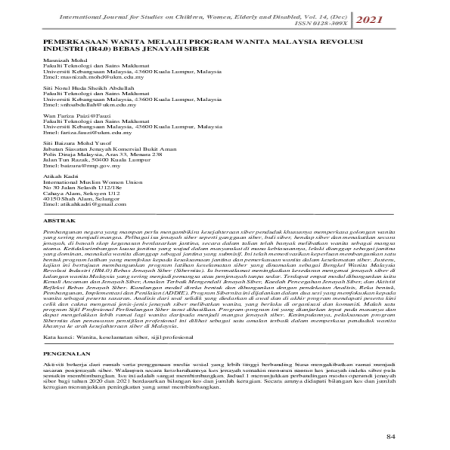
Pemerkasaan wanita melalui program wanita Malaysia Revolusi Industri (IR4.0) bebas jenayah siber
Item Type: Article
Editor:
Year: 00/12/2021
Abstract: Sustainable national development needs to take into account the cyber well-being of the population, especially empowering women who are often the victims. Various cybercrime issues such as cyber harassment, cyberbullying, cyber stalking and criminal intimidation, under the scope of gender-based violence, online have largely involved women as primary victims. The gender power imbalance that exists in a society where usually, men are considered the dominant gender while women are considered the submissive gender. This has motivated the need to develop a form of training program that focuses on gender equality and women’s empowerment in cyber security. Therefore, this study aims to develop a cyber security training program called the Bengkel Wanita Malaysia Revolusi Industri (IR4.0) Bebas Jenayah Siber (Sibernita).
|
|
|
|
|
|
Perceraian dalam kalangan wanita Melayu Terengganu
Item Type: Article
Editor:
Year: 00/12/2021
Abstract: This article analyzes the issue of divorce claims among Terengganu Malay women. Writing from a social history perspective, focusing on the period from 1963 to 1978 based on the written report of the Besut Kadhi Office obtained at the National Archives of Malaysia Terengganu Branch. The discussion of this article is divided into three parts. First, about background such as place of origin, age, length of time left, marital and family status and partner's occupation. Second, explain the factors that cause women to make complaints to religious parties that are related to the problem of neglecting alimony and responsibilities, polygamy and disappearing for a certain period of time. Third, removing the constraints faced such as hard-to-find couples who have migrated from their original area to a new place outside Terengganu or to another district in Terengganu as well as marriage with a partner from outside Terengganu. The findings of the study show that the Kadhi Besut Office plays an important role in solving problems related to the status of women who are suspended without strings. This study is expected to be able to fill the void in writing about Malaysian social history in general and gender studies in particular in the post-independence era.
|
|
|
|
|

|
Regulating retirement village in Malaysia; the way forward
Item Type: Article
Editor:
Year: 00/12/2021
Abstract: As Malaysia is predicted to be an ageing nation by the year 2030, developing a retirement village shall be an avenue for senior citizens to have a welfare and conducive placement for them to spend their time with value-added amenities that cater their special needs. This paper discusses the overview concept and elements of retirement village sector in Malaysia and other jurisdictions, and the possibility of having a sustainable legal framework in regulating the sector. The legal issues and possible unintended consequences that may arise out of the development of retirement village in Malaysia is also discussed in this paper.
|
|
|
|
|

|
Kemiskinan haid: krisis kesihatan awam yang perlu diakhiri
Item Type: Article
Editor:
Year: 00/12/2021
Abstract: Menstrual poverty is a situation when individual face difficulties in obtaining sanitary napkins (pads) or tampons due to financial constraints. It also refers to the lack or absence of sanitation facilities for managing menstruation such as no water supply or no proper waste disposal (sanitary pad) and no privacy to manage menstruation. In addition, lack of knowledge about menstruation and its management is another component of ‘menstrual poverty’. Awareness about ‘menstrual poverty’ needs to be created among the community and other stakeholders such as authorities associated with family and community institutions as well as volunteer organizations. Affected individuals also need to be empowered to speak out about the issues they face. With the pooling of resources and action from all stakeholders, this issue of ‘menstrual poverty’ can be addressed.
|
|
|
|
|

|
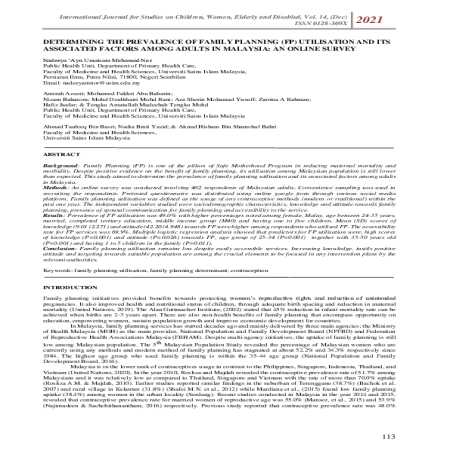
Determining the prevalence of family planning (FP) utilisation and its associated factors among adults in Malaysia: an online survey
Item Type: Article
Editor:
Year: 00/12/2021
Abstract: Family Planning (FP) is one of the pillars of Safe Motherhood Program in reducing maternal mortality and morbidity. Despite positive evidence on the benefit of family planning, its utilisation among Malaysian population is still lower than expected. This study aimed to determine the prevalence of family planning utilisation and its associated factors among adults in Malaysia.
|
|
|
|
|
|
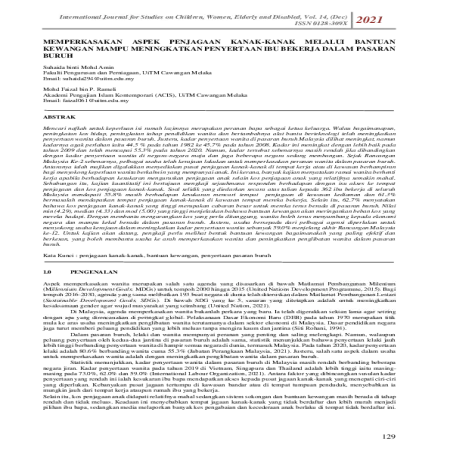
Memperkasakan aspek penjagaan kanak-kanak melalui bantuan kewangan mampu meningkatkan penyertaan ibu bekerja dalam pasaran buruh
Item Type: Article
Editor:
Year: 00/12/2021
Abstract: Since the 2nd Malaysia Plan in fact, various efforts have been made by the government to empower the role of women in the labour market. One of that is employers are encouraged to provide childcare centers at work or in nearby areas to support the needs of married women with children. This is because, many studies state that many women quit their jobs when faced with difficulties of managing childcare in addition to the relatively increasing cost of childcare. Therefore, this quantitative study aims to examine the extent to which respondents are faced with the issue of access to childcare and the cost of childcare. The survey distributed online to 362 working mothers across Malaysia found that 55.8% still faced difficulties in finding childcare in their residential areas and 61.3% had problems finding childcare in their working area.
|
|
|
|
|