


Browse by Type
|
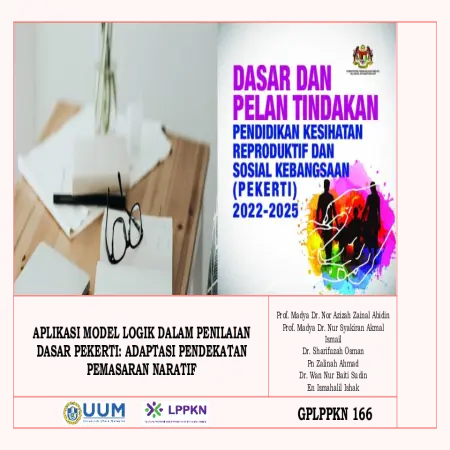
Aplikasi model, logik dalam penilaian Dasar PEKERTI: adaptasi pendekatan pemasaran naratif
Item Type: Conference or Workshop Item
Editor:
Year: 00/07/2026
Abstract: This study assesses the current performance of the PEKERTI policy by focusing on the challenges that limit its potential from achieving the set goals. The findings show that the policy’s achievements are moderate and reasonable. PEKERTI faces complex challenges due to the large target group and the varied implementation strategies. Meanwhile, the level of advocacy among agencies is relatively low, and policy implementation monitoring is found to be quite loose. This study suggests that the upcoming PEKERTI 3.0 should reorganize its implementation strategies to be more aligned and focused, while also strengthening advocacy strategies with the involved agencies. Policy implementation monitoring should also be improved through a more efficient data management system. A new narrative for the PEKERTI policy needs to be developed to strengthen public acceptance.
|
|
|
|
|
|
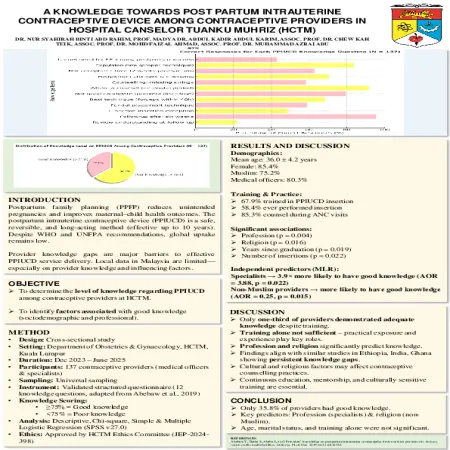
A knowledge towards post partum intrauterine contraceptive device among contraceptive providers in Hospital Canselor Tuanku Muhriz (HCTM)
Item Type: Scientific Poster
Editor:
Year: 00/11/2025
Abstract: Postpartum family planning (PPFP) reduces unintended pregnancies and improves maternal-child health outcomes. The postpartum intrauterine contraceptive device (PPIUCD) is a safe, reversible, and long-acting method(effective up to 10 years). Despite WHO and UNFPA recommendations, global uptake remains low. Objectives of this study are to determine the level of knowledge regarding PPIUCD among contraceptive providers at HCTM and to identify factors associated with good knowledge (Sociodemographic and professional). Conclusion only 35.8% of providers had good knowledge.
|
|
|
|
|
|
Apabila bilangan yang diinginkan berkurang: perubahan keinginan kesuburan dalam kalangan wanita Malaysia, 2004-2014
Item Type: Conference or Workshop Item
Editor:
Year: 00/11/2025
Abstract: The desire to have more children in Malaysia has declined as many people choose to have smaller families. Employment status is not a strong predictor. Education level was not a factor in 2004 in determining the desire for children, but in 2014, education influenced the desire. It is expected that the desire to have children will continue to decline in line with the reported decline in the Total Fertility Rate (TFR). Malaysia needs to plan measures and policies to prevent the negative effects of low fertility rates in the future. Malaysia needs an advocacy strategy that emphasizes the importance of having more children across age and ethnicity; government policies that directly and indirectly impact the desire to have one or more children (e.g. financial incentives, subfertility treatment, family-friendly workplaces, and a reformed early childhood education system)
|
|
|
|
|
|
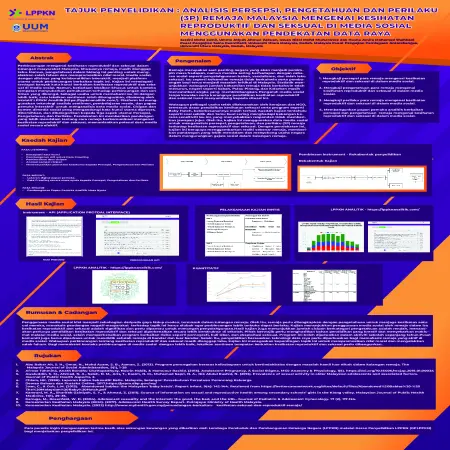
Analisis persepsi, pengetahuan dan perilaku (3P) remaja Malaysia mengenai kesihatan reproduktif dan seksual di media sosial menggunakan pendekatan data raya
Item Type: Scientific Poster
Editor:
Year: 00/11/2024
Abstract: Discussion on reproductive and sexual health among Malaysians, particularly adolescents, is still considered taboo. However, knowledge in this area is crucial to avoid misunderstandings and promote moral values. Social media, with its collaborative and interactive nature, has become the main platform for discussions on these topics. This study found that there are many keywords related to reproductive and sexual health on social media. However, the lack of a specific lexicon for the local context makes it difficult to understand the discussions and sentiments shared.
To better understand this issue, a sentiment lexicon has been developed, supported by the LPPKN Analytics initiative (https://lppknanalitik.com/). This platform uses sentiment analysis technology, machine learning, and interactive dashboards to analyze social media data. Tweets and comments on social media that contain key keywords are processed, cleaned, and categorized into three main aspects: Perception, Knowledge, and Behavior. This approach provides deeper insights into how adolescents communicate about reproductive and sexual health, effectively utilizing the potential of social media data.
|
|
|
|
|
|
Analisis persepsi, pengetahuan dan perilaku (3P) remaja Malaysia mengenai kesihatan reproduktif dan seksual di media sosial menggunakan pendekatan data raya
Item Type: Conference or Workshop Item
Editor:
Year: 00/11/2024
Abstract: Discussions on reproductive and sexual health among Malaysians, particularly teenagers, remain considered a taboo. However, knowledge in this field is essential to prevent misunderstandings and promote moral values. Social media, with its collaborative and interactive nature, has become the primary platform for discussions related to this topic. This study finds that there are many keywords related to reproductive and sexual health on social media. However, the lack of a specific lexicon for the local context complicates the understanding of discussions and sentiments shared. As an effort to better understand this issue, a sentiment lexicon has been developed, supported by the LPPKN Analytic initiative (https://lppknanalitik.com/). This platform uses sentiment analysis technology, machine learning, and interactive dashboards to analyze social media data. Posts and comments on social media containing key terms are processed, cleaned, and categorized into three main aspects: Perception, Knowledge, and Behavior. This approach provides a deeper insight into how teenagers communicate about reproductive and sexual health, effectively leveraging the potential of social media data.
|
|
|
|
|
|
Assessing the status of implementation of the Programme of Action of the International Conference on Population and Development and its contribution to the follow-up and review of the 2030 Agenda for Sustainable Development during the decade of action and deliver for sustainable development
Item Type: Newsletter
Editor:
Year: 00/06/2024
Abstract: Despite facing numerous challenges, there is a significant progress has been made over the past 30 years since the implementation of the Programme of Action in Malaysia. This includes improvements such as increased life expectancies as well as better access to services and education on sexual and reproductive health.
|
|
|
|
|

|
Analisis literatur menangani isu keganasan rumah tangga demi membangun Malaysia Madani
Item Type: Book Section
Editor:
Year: 00/12/2023
Abstract: Domestic violence is one of the branches of the discussion of family counseling issues among counselors in Malaysia. Domestic violence is a social problem that has adverse effects on women and children from physical, psychological and social aspects. This study was conducted to detail the findings of a semi-structured interview with an Information Officer of the Nur Sejahtera Clinic of the National Population and Family Development Board (NPFDB) and an Assistant Officer of the Jabatan Kebajikan Masyarakat Malaysia (JKMM) as well as a literature review related to definitions, propositions / Nas Al-Quran, factors , elements of legislation, intervention, Islamic approach, and measures to overcome the issue of domestic violence.
|
|
|
|
|
|
Active engagement and health status of older Malaysians evidence from a household survey
Item Type: Article
Editor:
Year: 17/03/2023
Abstract: Malaysia is undergoing rapid age structural shift to becoming an ageing nation by 2030 when 14% of its population will be aged 60 and over. Population ageing strains the healthcare system due to the rapid rise in non-communicable diseases and poses enormous challenges in providing social protection.
|
|
|
|
|
|
A world of 8 billion: Towards a resilient future, harnessing opportunities and ensuring rights and choices for all
Item Type: Newsletter
Editor:
Year: 00/11/2022
Abstract: The world's population is projected to reach 8 billion on 15 November 2022. The best way to ensure demographic resilience is to support human rights, including individuals' reproductive rights and choices.
|
|
|
|
|
|
Autonomy in household decision-making among Malaysia women
Item Type: Thesis
Editor:
Year: 00/06/2022
Abstract: The progress of Malaysian women has significantly improved since 1980, particularly in terms of educational achievement. However, women's labor force participation rate, level of women in decision-making at the household and industry levels, is still below that of men. These instances suggested that there were still obstacles to women's empowerment
in Malaysia, particularly in decision-making. Hence, this study aims to identify factors affecting women's autonomy in household decision-making among married women in Malaysia. Data on women's autonomy in household decision-making were obtained from Fifth Malaysian Population and Family Survey in 2014 and accounted for 2595 married women aged 15-59. Kishor's Conceptual Framework and Three-domains of Women's Empowerment were adopted as a research framework. The study framework consisted of ten exogenous factors and endogenous variables of women's autonomy in household decisions. The household decision-making was divided into eight domains: household expenses, buying a house, making assets, family savings, family holidays, children's discipline, children's education, and woman's career. Each household decision domain had responses of three levels of women's autonomy (not involved, joint and sole participation) and was analyzed individually using the Multinomial Logistics Regression method. The study provides evidence that women's characteristics can restrict the
autonomous power of women in a patriarchal society like Malaysia. All selected factors significantly impacted women's autonomy in at least one decision domain in the household. Women's education was the most substantial factor that positively influenced women's autonomy in all decisions in the household. In contrast, the spousal education gap and participation in the labor force could be a barrier to women's autonomy in the household. The family should be at the forefront of the empowering process as a woman's role in caring for the family's welfare is definite. Despite the continuous efforts to empower women, the study suggested that there is a need for a balance in shaping the positive patriarchal values among the communities, particularly among men. This can be achieved by promoting shared responsibility within a household, and this initiative has the same substantial weightage as a woman's education and economic status.
|
|
|
|
|
