Browse by Type
|
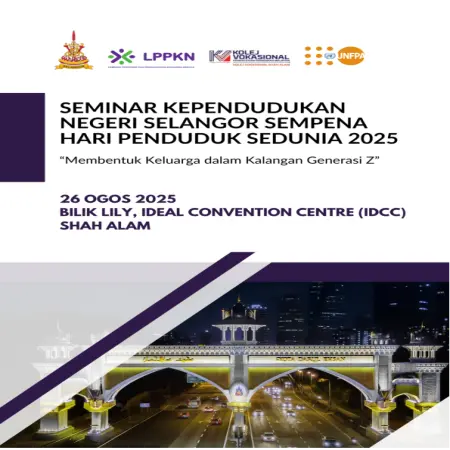
Laporan Seminar Kependudukan Negeri Selangor Sempena Hari Penduduk Sedunia 2025
Item Type: Report
Editor:
Year: 00/08/2025
Abstract: In conjunction with the 2025 World Population Day celebration at the Selangor state level, the Selangor state of National Population and Family Development Board (LPPKN) in collaboration with the Selangor State Government and Shah Alam Vocational College organized the Selangor State Population Seminar at the Ideal Convention Centre, Shah Alam, Selangor on 26 August 2025. The theme of the Selangor state level World Population Day celebration this time is “Forming Families Among Generation Z”. Also held at this celebration was the Population Forum titled “Having a Family: Gen Z Ready or Not?”. Three (3) working paper presentations were also presented, namely male reproductive health, family well-being and early marriage.
|
|
|
|
|
|
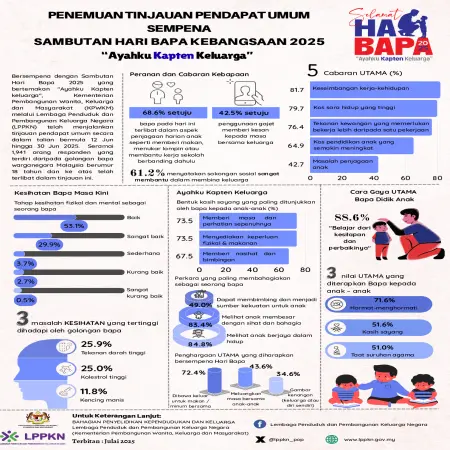
Penemuan Tinjauan Pendapat Umum Sempena Sambutan Hari Bapa Kebangsaan 2025 “Ayahku Kapten Keluarga”
Item Type: Infographic
Editor:
Year: 00/07/2025
Abstract: In conjunction with the 2025 Father’s Day celebration themed “My Father, the Family Captain,” the Ministry of Women, Family and Community Development (KPWKM), through the National Population and Family Development Board (NPFDB), conducted an online public opinion survey from 12 June to 30 June 2025. A total of 1,941 respondents, consisting of Malaysian fathers aged 18 and above, participated in this survey.
|
|
|
|
|
|
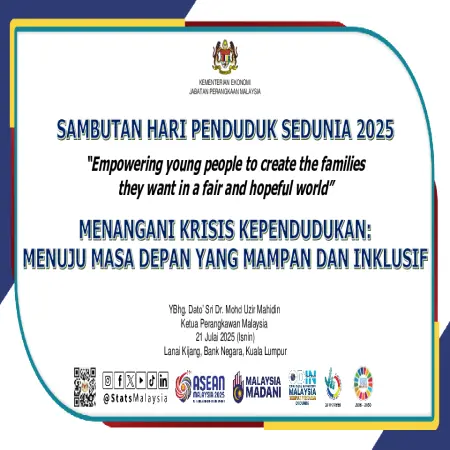
Menangani krisis kependudukan: menuju masa depan yang mampan dan inklusif
Item Type: Conference or Workshop Item
Editor:
Year: 00/07/2025
Abstract: The phenomenon of depopulation will become a new challenge for Malaysia in 2060. The population is projected to peak in 2059 at an estimated 42.38 million people. The total fertility rate (TFR) will decline to 1.4 by 2060. The average age of mothers at first live birth will increase (2023: 28 years). Median age at marriage: men: 28.0 years, women: 27.0 years in 2023. Household size is decreasing to 3.7 (2024), 5.2 (1980). Life expectancy is increasing, men: 77.2, women: 81.5. The evolution of national socio-economic strengthening focuses on restructuring the economy for a quality life for the people. As the leader in official statistics, Department of Statistics Malaysia (DOSM) will begin to release aggregate/statistical data at granular levels regularly. Trusted figures and data are the lifeblood of growth and fairer distribution.
|
|
|
|
|
|
Isu kesuburan: cabaran global, tanggungjawab bersama
Item Type: Conference or Workshop Item
Editor:
Year: 00/07/2025
Abstract: Malaysia is expected to reach an aging society status by the year 2035, in line with the trend of declining total fertility rate (TFR) of the country, which is currently below the replacement level of 2.1 children per woman. The state of Kedah also reflects the same pattern, registering a TFR of around 1.7 to 1.8 according to DOSM data (2022). This decline has significant implications for the future workforce, social support systems, and the state's economic stability, especially in facing the challenges of an aging population and a long-term decrease in population growth rate.
|
|
|
|
|
|
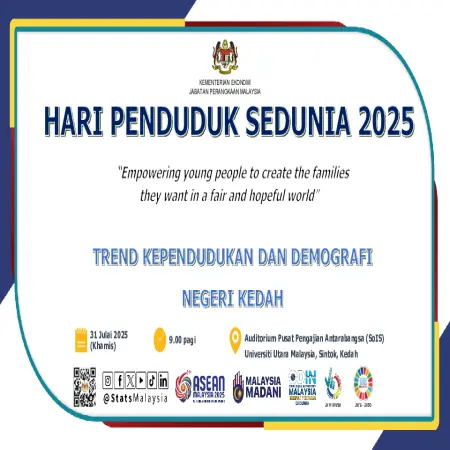
Trend Kependudukan dan demografi Negeri Kedah
Item Type: Conference or Workshop Item
Editor:
Year: 00/07/2025
Abstract: Kedah recorded a population of 2.2 million, the sixth highest population in Malaysia. Live births in Kedah showed a declining trend from 2017 until 2022 and increased again in 2023. The phenomenon of depopulation puts pressure on the workforce and population distribution. The focus is on development for the elderly population to maintain functional capacity for general well-being. More comprehensive planning and policies regarding fertility components are needed to maintain a more stable population growth in the long term.
|
|
|
|
|
|
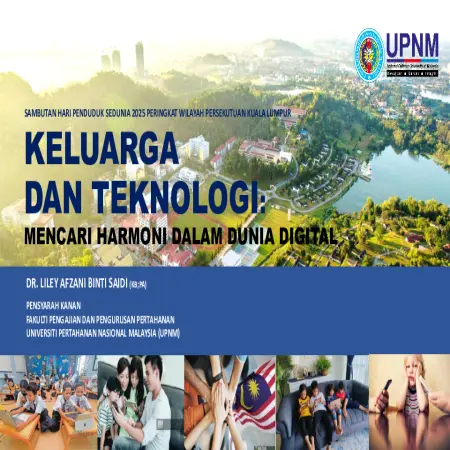
Keluarga dan teknologi: mencari harmoni dalam dunia digital
Item Type: Conference or Workshop Item
Editor:
Year: 00/07/2025
Abstract: Harmony of technology in the family is not about rejecting technology but using technology consciously (mindful tech use), setting psychological and time boundaries, strengthening 'connection before correction'—emotions first, discipline later—and building a digital family structure with values and spirituality as the foundation.
|
|
|
|
|
|
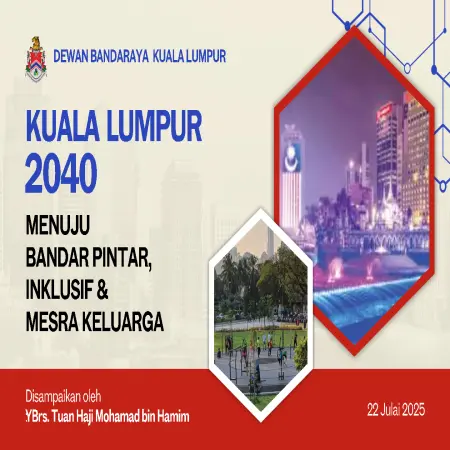
Kuala Lumpur 2040: menuju bandar pintar, inklusif dan mesra keluarga
Item Type: Conference or Workshop Item
Editor:
Year: 00/07/2025
Abstract: Dewan Bandaraya Kuala Lumpur (DBKL) is committed to realizing the Kuala Lumpur Structure Plan 2040, which aspires to shape Kuala Lumpur as a smart, inclusive, and family-friendly city. This approach focuses on sustainable, resilient, and high-tech development to improve the quality of life of urban residents and to make Kuala Lumpur a globally competitive city in terms of economy and society.
|
|
|
|
|
|
Tahap Kualiti dan Kesejahteraan Hidup Belia Malaysia
Item Type: Conference or Workshop Item
Editor:
Year: 00/07/2025
Abstract: The Malaysian Youth Research and Development Institute (IYRES) is a national research center that studies various aspects of the trends and development of the younger generation and their connection to changes occurring at the national, regional, and international levels. IYRES produces high-impact research and provides input for the formulation of youth development policies and strategies. The studies conducted include the Malaysian Youth Index and the Malaysian Youth Mental Health Index. The plans and policies developed include the Youth Socioeconomic Empowerment Plan.
|
|
|
|
|
|
Pemetaan data penduduk bandar untuk perancangan sosial
Item Type: Conference or Workshop Item
Editor:
Year: 00/07/2025
Abstract: The importance of statistics for national development is to measure the current situation; identify current issues and gaps; formulate policies and action plans; monitor implementation; evaluate achievements; correct and realign.
|
|
|
|
|
|
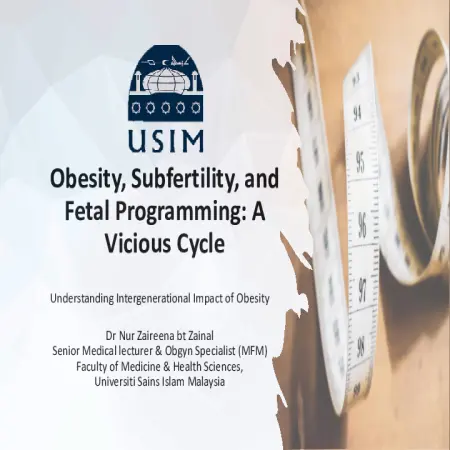
Obesity, subfertility and fetal programming: a vicious cycle
Item Type: Conference or Workshop Item
Editor:
Year: 00/07/2025
Abstract: Obesity increasing rapidly, especially among reproductive age women. Obesity affects fertility, pregnancy outcomes, and future generations. Obesity disrupts reproductive hormones and leads to anovulation, PCOS, poor oocyte quality. Maternal obesity leads to pregnancy complications. Fetus exposed to hyperglycemia and oxidative stress.
|
|
|
|
|