Browse by Type
|
The development of Family Well-Being Index: Malaysia experience. EGM on interlinkages between migration, urbanization, new technologies, demographic trends and climate change in Asia.
Item Type: Conference or Workshop Item
Editor:
Year: 00/05/2024
Abstract: The Malaysian Family Well-Being Index (MFWBI) was initiated in 2011 by the NPFDB with the aim to measure the levels of family well-being in the country and to recommend strategic initiatives to strengthen the implementation of future family intervention programs in Malaysia. In 2016, measurement of the MFWBI was repeated using an improvised instrument. The MFWBI 2016 had maintained all the 7 domain in the MFWBI 2011 and added one more domain, namely, Family and Communication Technology. The instrument’s refinement exercise was repeated again in 2019, and 2022 in order to measure the family well-being. The purpose of the refinement exercise was to ensure that the questionnaire was valid and relevant for current and near future use. The domain in the MFWBI are Family Relationship, Family Economy, Family Health, Family Safety, Family and Community Engagement, Role of Religion & Spiritual Practice, Housing and Environment, Family and Communication Technology. At the national level, the MFWBI has been recognized by the federal government as one of the national KPI in the country’s 5-year development planning (Eleventh Malaysia Plan, 2016 -2020 and Twelfth Malaysia Plan, 2012 – 2025).
|
|
|
|
|
|
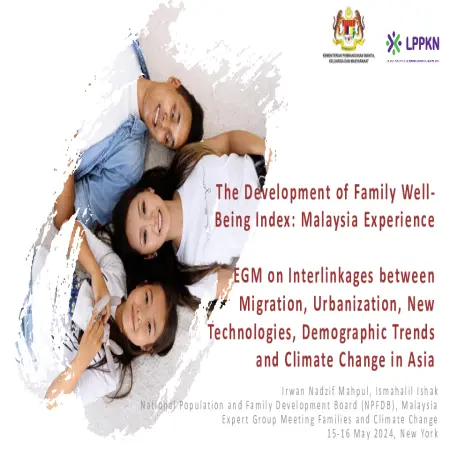
Malaysia's demographic dividend: harnessing the first and the second
Item Type: Newsletter
Editor:
Year: 00/12/2023
Abstract: In 2020, Malaysia's economy was one of the largest in Southeast Asia, boasting a population of 32.4 million. As a relatively young country, Malaysia has undergone significant improvements in education and healthcare facilities over the last few decades, leading to rapidly changing demographics. These changes in the population structure will open windows of opportunity to harness the first and second demographic dividends.
|
|
|
|
|
|
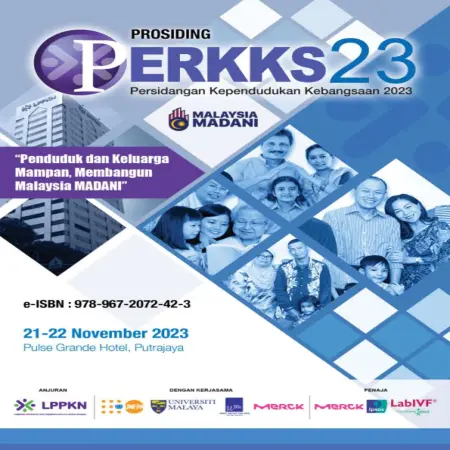
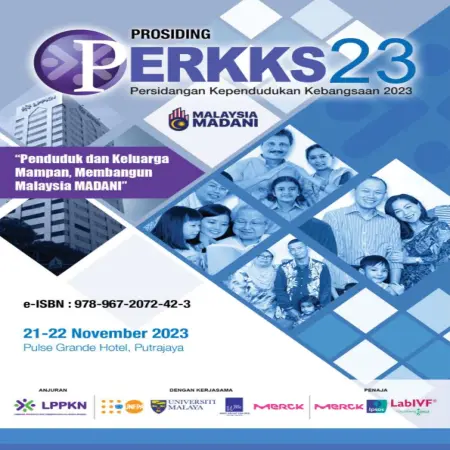
Prosiding Persidangan Kependudukan Kebangsaan 2023 (PERKKS 23): “Penduduk dan Keluarga Mampan, Membangun Malaysia MADANI”
Item Type: Book
Editor:
Year: 00/12/2023
Abstract: Collection of papers presented during the 2023 National Population Conference (PERKKS 23), 21-22 November 2023, Pulse Grande Hotel, Putrajaya.
|
|
|
|
|
|
Faktor kritikal mendepani isu dan cabaran tenaga kerja menua
Item Type: Book Section
Editor:
Year: 00/12/2023
Abstract: An aging workforce is one of the few phenomena faced by countries experiencing an aging population. This is also the case in Malaysia which has been categorized as an aging country by the World Bank since 2020. The aging workforce poses a number of issues and challenges to policy makers, employers and employees, especially those who are going through the aging process themselves.
|
|
|
|
|
|
Perceived social support, mental health and quality of life among recipients of old age financial assistence
Item Type: Book Section
Editor:
Year: 00/12/2023
Abstract: The present study examines multidimensional perceived social support, mental health and quality of life (QOL) in older adults aged 60 years and older who receive the financial assistance provided by the Department of Social Welfare. A cross-sectional study approach was conducted among 487 older adults living in Selangor, Malaysia, who are the recipients of old age financial assistance known as Bantuan Warga Emas (BWE).
|
|
|
|
|
|
Kesan peralihan demografi terhadap kebajikan sosial dan pasaran buruh: perbincangan kumpulan fokus
Item Type: Book Section
Editor:
Year: 00/12/2023
Abstract: Demographic transition refers to changes in the population structure of a country, mainly related to factors such as birth rate, mortality rate and life expectancy of the population. This study aims to identify the effects of demographic transition on social welfare and labour market conducted in Shah Alam, Selangor among heads of household.
|
|
|
|
|
|
The Evolution of a Progressively Graying Staff: A Bibliometric Analysis
Item Type: Book Section
Editor:
Year: 00/12/2023
Abstract: The development of research on demographic and related aspects of the ageing workforce is crucial to resolve the labour shortage issue and the increase in retirement age.
|
|
|
|
|
|
The linkage of government assistance programs towards digital and financial well-being of small household income families in urban area during covid-19 pandemic
Item Type: Book Section
Editor:
Year: 00/12/2023
Abstract: The Covid-19 pandemic and the Movement Control Order (MCO) have had a negative impact on the financial well-being and digital well-being of B40 or small household income families in urban areas. In responding to the crisis, the government had launched multiple assistance programs to assist the group. Hence, the study intends to examine the relationship of government assistance towards digital and financial well-being of the group.
|
|
|
|
|
|
Emosi dan kesihatan mental ibu bapa di fasa endemik covid-19: hasil penemuan kajian tinjauan pendapat umum LPPKN di Negeri Terengganu
Item Type: Book Section
Editor:
Year: 00/12/2023
Abstract: Post Covid-19 had an impact on family institutions mainly in terms of preparation of family members especially parents in facing life post-pandemic Covid-19. This study aimed to identify the emotional and mental health levels of parents in the endemic phase of Covid-19 in Terengganu.
|
|
|
|
|
|
Women in Malaysian Animation Films: Characters and Roles
Item Type: Book Section
Editor:
Year: 00/12/2023
Abstract: The area of animation is currently seeing significant growth and development in Southeast Asia, with particular emphasis on the nation of Malaysia. At this point, Malaysia has demonstrated a notable proficiency in the creation of animated films of superior quality and substantial scope. Animations have emerged as a significant component in the advancement of display media during the Fourth Industrial Revolution (IR 4.0). These animations serve as a medium that indirectly facilitates the process of teaching and learning.
|
|
|
|
|