Browse by Type
|
Apabila bilangan yang diinginkan berkurang: perubahan keinginan kesuburan dalam kalangan wanita Malaysia, 2004-2014
Item Type: Conference or Workshop Item
Editor:
Year: 00/11/2025
Abstract: The desire to have more children in Malaysia has declined as many people choose to have smaller families. Employment status is not a strong predictor. Education level was not a factor in 2004 in determining the desire for children, but in 2014, education influenced the desire. It is expected that the desire to have children will continue to decline in line with the reported decline in the Total Fertility Rate (TFR). Malaysia needs to plan measures and policies to prevent the negative effects of low fertility rates in the future. Malaysia needs an advocacy strategy that emphasizes the importance of having more children across age and ethnicity; government policies that directly and indirectly impact the desire to have one or more children (e.g. financial incentives, subfertility treatment, family-friendly workplaces, and a reformed early childhood education system)
|
|
|
|
|
|
Penilaian ke atas Program Pendidikan Kesihatan Reproduktif dan Sosial (PEKERTI) di Institut Pengajian Tinggi Awam (IPTA) dengan menggunakan model penilaian Kirkpatrick
Item Type: Conference or Workshop Item
Editor:
Year: 00/11/2025
Abstract: The PEKERTI program was introduced by the Ministry of Women, Family and Community Development (KPWKM) through the National Population and Family Development Board (LPPKN) starting in 2009. Its main purpose is to produce individuals who are knowledgeable and have positive attitudes in reproductive and social health aspects. The National Reproductive and Social Health Education Policy and Action Plan (PEKERTI) 2022-2025 has improved the PEKERTI program until introducing the National PEKERTI program in 2025. The objective of the study is to measure the effectiveness of the program using the 4-stage Kirkpatrick Model. In conclusion, the program is effective in increasing knowledge, confidence, and commitment, but the effect is still moderate. Future focus is to increase involvement, satisfaction and interactive activities for better learning effects. Follow-up interventions after the program can close the gap between knowledge and practice (confidence & commitment).
|
|
|
|
|
 |
Podcast KASIH Lensa Keluarga - Generasi Sandwich: Realiti Keluarga Masa Kini?
Item Type: Video
Editor:
Year: 11/09/2025
Abstract: Modern families are increasingly caught in a complex balancing act — raising their own children while simultaneously caring for ageing parents. This episode of the KASIH Lensa Keluarga Podcast, titled "Generasi Sandwich: Realiti Keluarga Masa Kini?", explores the emotional, financial, and physical strain experienced by individuals caught between two caregiving roles. Featuring Rosmonaliza Abdul Ghani, Director of the Family Well-being Division at LPPKN, and hosted by Ally Iskandar, the discussion sheds light on the challenges and resilience of Malaysia’s “sandwich generation.” It highlights the urgent need for awareness, empathy, and systemic support to safeguard their well-being while they continue to uphold both ends of the family spectrum.
|
|
|
|
|
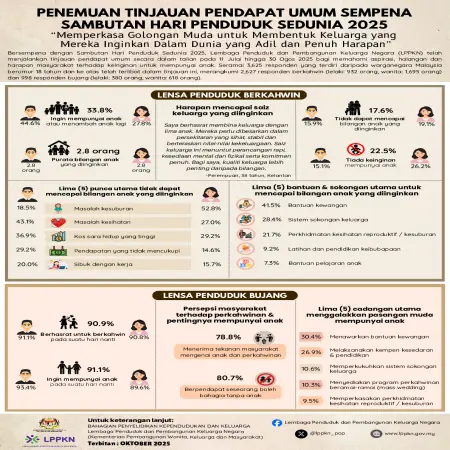
Penemuan Tinjauan Pendapat Umum Sempena Sambutan Hari Penduduk Sedunia 2025
Item Type: Infographic
Editor:
Year: 00/09/2025
Abstract: In conjunction with the 2025 World Population Day Celebration themed 'Empowering Young People to Shape the Families They Want in a Just and Hopeful World”, the National Population and Family Development Board (NPFDB) conducted an online public opinion survey from July 1 to August 30, 2025, to understand the aspirations, obstacles, and hopes of the community regarding the desire to have children. A total of 3,625 respondents, consisting of Malaysian citizens aged 18 and above, participated in this survey, including 2,627 married respondents (men: 932; women: 1,695) and 988 single respondents (men: 380; women: 618).
|
|
|
|
|
|
Video Korporat Kerja Lapangan Kajian Penduduk dan Keluarga Malaysia Keenam (KPKM-6)
Item Type: Video
Editor:
Year: 00/09/2025
Abstract: The Sixth Malaysian Population and Family Survey (MPFS-6) 2024 is the sixth study in a series of surveys conducted by the National Population and Family Development Board (NPFDB) since 1974. This study aims to provide up-to-date information and time-series data related to population, family, and reproductive health of the Malaysian population. The MPFS-6 fieldwork was conducted from August 28, 2024 until February 28, 2025.
|
|
|
|
|

|
|
Podcast KASIH Lensa Keluarga: Generasi Muda: Kerja Dulu, Kahwin Kemudian?
Item Type: Video
Editor:
Year: 07/08/2025
Abstract: This episode of the KASIH Lensa Keluarga Podcast explores the question faced by many young adults today: Should one prioritise building a career before marriage, or marry first and establish a career later? Increasingly, younger generations are choosing to focus on career development before starting a family, but is this choice ideal for everyone? The discussion features Md Noh Saiman, Chief Assistant Director, Counselling and Intervention Unit, LPPKN, and Ryan Deedat, singer and social media influencer. Together, they will share insights from professional and youth perspectives on how career aspirations, relationships, and personal values influence decisions about marriage and life choices. The session aims to foster deeper reflection on balancing work, love, and long-term aspirations among Malaysia’s younger generation.
|
|
|
|
|
|
Podcast KASIH Lensa Keluarga: Kahwin Lewat: Pilihan atau Tekanan?
Item Type: Video
Editor:
Year: 22/08/2025
Abstract: Marriage is often seen as a milestone in life, yet many young adults today are choosing—or feeling compelled—to delay it. This episode of the KASIH Lensa Keluarga Podcast explores the timely question, Kahwin Lewat: Pilihan atau Tekanan? Is the decision shaped by career ambitions, emotional readiness, or the weight of societal expectations? Bringing together both professional expertise and lived experience, the conversation features Puan Noor Azlin Muhammad Sapri, Chief Assistant Director at LPPKN, and renowned singer, host, and celebrity Sissy Imann. Moderated by Ally Iskandar, the discussion offers thought-provoking insights into how personal aspirations, cultural norms, and social pressures intertwine in shaping decisions about love, commitment, and the future. The session aims to spark reflection among Malaysia’s younger generation on redefining marriage within the realities of modern life.
|
|
|
|
|
Trend kesuburan di Malaysia: implikasi kepada pembangunan negara
Item Type: Conference or Workshop Item
Editor:
Year: 00/08/2025
Abstract: The number of Malaysian families is increasing, but family size is getting smaller. Marriages are increasingly being delayed, especially as the divorce rate has doubled since 2010. The scenario of fertility rate changes in Malaysia shows a declining trend. The crude birth rate in Malaysia also shows a drastic decrease. The rapid decline in fertility rate (TFR) will accelerate the country's aging process. LPPKN services can be one of the effective strategies that can support Malaysia in facing the scenario of declining fertility.
|
|
|
|
|
|
Undang-undang, hak wanita dan kesejahteraan sosial
Item Type: Conference or Workshop Item
Editor:
Year: 00/08/2025
Abstract: Tracing the role of law in ensuring women's rights in Malaysia by looking at the existing legal framework and related policy developments, as well as assessing the extent to which the empowerment of women's rights has a positive impact on the formation of social welfare in various aspects of life. Finally, suggesting several strategic measures in the form of improvements to laws and public policies to systematically and inclusively strengthen women's rights.
|
|
|
|
|
|
Kepelbagaian Identiti Seksual : pendekatan agama dan psikososial dalam membina keluarga sejahtera
Item Type: Conference or Workshop Item
Editor:
Year: 00/08/2025
Abstract: The issues of sexual identity and gender confusion need to be viewed wisely and in an integrated manner. The combination of religious and psychosocial approaches is the main key. A prosperous family is built on the foundation of religion, love, natural values, and continuous education.
|
|
|
|
|