TOPICS
Results for Topics : "Population"
|
SDGS and the impact of megatrends on Families: perspectives from Malaysia
Item Type: Conference or Workshop Item
Editor:
Year: 00/05/2024
Abstract: 57th Commissions on Population and Development (CPD57): Assessing the status of implementation of the Programmed of Action of the International Conference on Population and Development and its contribution to the follow-up and review of the 2030 Agenda for Sustainable Development during the decade of action and delivery for sustainable development. Strengthening Malaysian Families in era of megatrends, National Population and Family Development Board Malaysia (NPFBD) had LPPKN Family Centre, Nur Sejahtera Clinic Services, Population and Family Research, Training and education (family), Counseling service and program, online accessibility etc.
|
|
|
|
|

|
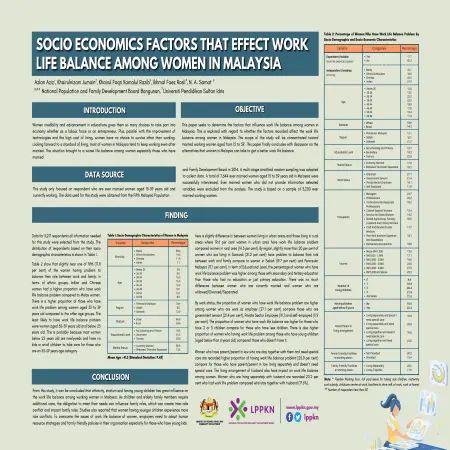
Socio economics factors that effect work life balance among women in Malaysia
Item Type: Scientific Poster
Editor:
Year: 00/00/2021
Abstract: This paper seeks to determine the factors that influence work life balance among women in Malaysia. This is explored with regard to whether the factors recorded affect the work life balance among women in Malaysia. The scope of the study will be concentrated toward married working women aged from 15 to 59. This paper finally concludes with discussion on the alternatives that women in Malaysia can take to get a better work life balance.
|
|
|
|
|
|
Subjective well-being of the Malaysian citizen: preliminary development of survey instrument
Item Type: Article
Editor:
Year: 00/03/2020
Abstract: A questionnaire is a well-known measurement instrument used by most of the researchers when conducting a survey. It is a powerful tool for collecting data in survey research. It should be noted that the quality of a measurement instrument used plays a key role in ensuring the quality of data gained in the survey. Therefore, it has become essential for the researchers to carefully design their questionnaire so that the quality of the data obtained can be preserved. Then, it is also vital for the researchers to assess the quality of the data obtained before it can be successfully used for further analysis. This article discussed an early process involved in development of the survey instrument for the purpose of assessing subjective well-being of the Malaysian citizen. These include operationalization of definition, identification of the important dimension and indicators of subjective well-being, rating scale and content validity of the items with the experts.
|
|
|
|
|

|
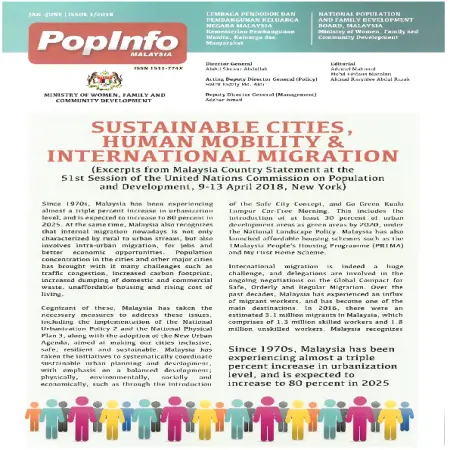
Sustainable cities, human mobility & international migration
Item Type: Newsletter
Editor:
Year: 00/00/2018
Abstract: Over the past decades, Malaysia has experienced and influx of migrant workers, and has become one of the main destinations. In 2016, there were an estimated 3.1 million migrants in Malaysia, which comprises of 1.3 million skilled workers and 1.8 million unskilled workers.
|
|
|
|
|
|
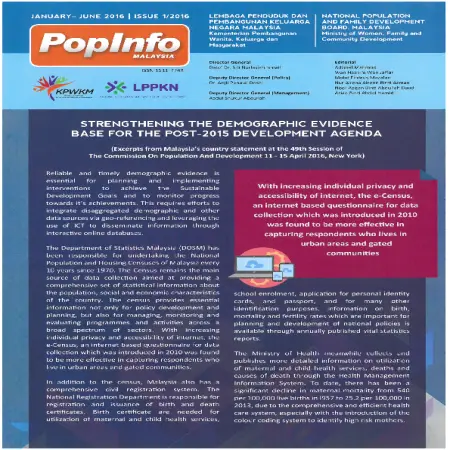
Strengthening the demographic evidence base for the post-2015 development agenda
Item Type: Newsletter
Editor:
Year: 01/07/2016
Abstract: In Malaysia, the implementation of the post-2015 development agenda has obtained the highest political commitment at the national level and has continuously involved multi-stakeholders engagement under the 11th Malaysia development plans (2016-2020). Malaysia will also further improve the availability of online interactive databases and access to geo-referenced datasets disaggregated by relevant characteristics such as income, gender, age, ethnicity and disability, to ensure that no one is left behind.
|
|
|
|
|
|
Second Population Strategic Plan Study : Executive Summary
Item Type: Book
Editor:
Year: 00/09/2012
Abstract: The Second Population Strategic Plan Study was conducted from July 2008 – December 2009 by the Ministry of Women, Family and Community Development through the National Population and Family Development Board. This study is a follow-up to the 1st Population Strategic Plan Study conducted in 1992. The objectives of the Second Population Strategic Plan Study are to assess and evaluate the implementation of the national population programme in the context of current policies; and to recommend a strategic plan of action framework for the implementation of future population and development programmes.
|
|
|
|
|
|
Strategi kelangsungan hidup pekerja asing warga Indonesia dan implikasi sosial akibat kehadiran mereka di Sabah
Item Type: Conference or Workshop Item
Editor:
Year: 00/00/2012
Abstract: Sabah's direction focuses on the development of 3 main sectors such as agriculture, tourism and manufacturing to drive the economy. As an agro -economy -based state, the 2010 census recorded 30 per cent of the total workforce engaged in the agricultural sector. As locals are not interested in seizing employment opportunities in the 3D -based agriculture and plantation sector (Difficult, Dirty & Dangerous), job vacancies are filled mainly by Indonesian workers as shown in data obtained from Temporary Work Visit Passes (TWVP). Certainly, their presence has social implications for the state of Sabah which housed 27.7 percent of the foreign population in 2010. Therefore, a micro study needs to be conducted to understand and analyze this situation. A joint study was conducted with NPFDB, in which a total of 896 respondents consisting of Indonesian workers from the plantation, manufacturing, construction, services and informal sectors were interviewed in a survey in the Tawau Division in 2010. In addition, primary data were also collected from interviews. Conducted among legal and illegal employees as well as based on the researcher’s observations. Interviews with government officials directly involved with the management and recruitment of foreign workers were also conducted. Secondary data were obtained from various government agencies in Sabah such as the Immigration Department, Manpower Department, Statistics Department, Health Department and Education Department. This study successfully identified 5 survival strategies that are often used by Indonesian workers to ensure the success of their migration, namely family networking, choice of residence, cultural adaptation and assimilation, economic survival and involvement in social and political institutions. Of course, the implementation of this strategy has a social impact on the local people. Important findings of this study show that most Indonesian workers come to Sabah with family members. Certainly the presence of spouses and children has huge implications for social facilities especially health and education. Therefore, there must be integration between the entry of foreign workers with Sabah's development planning, especially if the dependence on foreign labor continues until Sabah achieves the status of a technology - intensive economy in the future.
|
|
|
|
|