Browse by Type
|
Teen pregnancy and sex education
Item Type: Article
Editor:
Year: 00/00/2019
Abstract: Teenage pregnancy refers to any pregnancy in women or girls aged 19 years or younger. In 2016, the Ministry of Health recorded more than 12,000 teenage pregnancies in Malaysia. The National Registration Department reported that 4,992 children were born out of wedlock to girls aged 18 years and below. Teenage pregnancy is associated with immediate as well as long-term health risks. It is also accompanied by a number of negative consequences that are detrimental to the well-being of young mothers – disruption of education, limitation of opportunities for self-development and employment, social stigma and increased exposure to violence and exploitation. This article examines some circumstances resulting in teenage pregnancy and explores ways to support teenagers who face difficulties resulting from unintended pregnancy.
|
|
|
|
|


|
Malaysia negara tua 2030
Item Type: Infographic
Editor:
Year: 00/12/2018
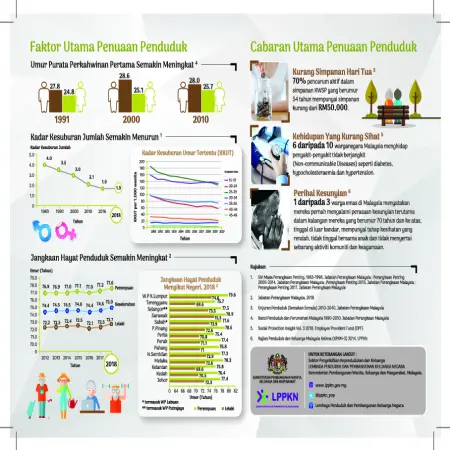
Abstract: This infographic shows about the main factors and challenges of aging in Malaysia. According to the United Nations (UN) definition, senior citizens are among those aged 60 and above. This definition was introduced during the “World Assembly on Aging” held in Vienna in 1982. In recognition of the elderly, the UN through Resolution No. 45/106 has also declared October 1 as International Senior Citizens Day. In Malaysia, the National Senior Citizens Day celebration has been celebrated on October 1 every year since 1992.
|
|
|
|
|
|
Analisis situasi kependudukan dan kekeluargaan di Malaysia
Item Type: Research Report
Editor:
Year: 01/12/2018
Abstract: The evolution of population and family policy in this country has begun since the implementation of the National Family Planning Programme by the National Family Planning Board (NFPB) in 1966. The main purpose of the programme was to reduce the population growth rate from 3% to 2% by 1985. Apart from Malaysia, other Asian countries also introduced
a family planning programme to its population in the 1960s where the earliest country to introduce the programme was India around the 1950s. As a result of the introduction of the family planning programme in the 1960s, the country’s gross birth rate has decreased from 36.7 babies in 1966 to 31.5 babies per 1,000 population in 1985. This directly makes the average annual population growth rate of the country declined from 3.0% per annum in 1966 to 2.8% per annum in 1980.
|
|
|
|
|
 |
Development of Malaysian women fertility index
Item Type: Article
Editor:
Year: 00/11/2018
Abstract: A fertility rate is a measure of the average number of children a woman will have during her childbearing years. Malaysia is now facing a population crisis and the fertility rate continues to decline. This situation will have implications for the age structure of the population where percentages of senior citizens are higher than percentages of people aged below 5 years old. Malaysia is expected to reach aging population status by the year 2035. As the aging population has a very long average life expectancy, the government needs to spend a lot on medical costs for senior citizens and need to increase budgets for pensions. The government may be required to increase tax revenues to support the growing older population. The falling fertility rate requires proper control by relevant authorities, especially through planning and implementation of strategic and effective measures. Hence, this paper aims to develop a fertility index using correlation and Shannon's entropy method. The results show that Selangor, Johor, and Sarawak are among the states with the highest values of the fertility index. On the other end of the spectrum, Terengganu, W.P. Labuan, and Perlis are ranked in the last positions according to the fertility index. The information generated from the results in this study can be used as a primary source for the government to design appropriate policies to mitigate dwindling fertility rates among Malaysian women.
|
|
|
|
|
Fertility preferences in Malaysia
Item Type: Book Section
Editor:
Year: 30/11/2018
Abstract: Most countries have been experiencing changes in fertility pattern over the last few decades. Fertility transition from high to low is a relatively recent phenomenon in Malaysia. The total fertility rate (TFR) had declined from 4.9 children per woman in 1970 to 4.0 in 1980. It has continued to fall and has reached the replacement level of 2.1 in 2010. This chapter provides the trend analysis and a comparative analysis of fertility trends to explain the fertility transition of Malaysia’s population. Data used in this study were obtained from Department of Statistics, Malaysia and Fifth Malaysian Population and Family Survey, 2014. The result of this study showed that the fertility rate between age groups was higher among Malay than other ethnics since 1991–2010. Across all ages, the fertility rate has a negative correlation with the educational level where women with tertiary education tend to have fewer children compared to less educated women. This study also presents the fertility desire in Malaysia. There is a negative correlation between age group and fertility desire. In addition, the desire to stop childbearing is found to be stronger when women have had three living children. The findings of this study will help policy makers to plan programmes to improve the fertility rate in Malaysia.
|
|
|
|
|
|
Panduan keselamatan di dalam dan luar rumah
Item Type: Article
Editor:
Year: 00/11/2018
Abstract: These tips are taken from the “Pendidikan Keselamatan Keluarga dan Anak (PEKA)” module that was introduced by the National Population and Family Development Board (NPFDB) last year. It aims to provide knowledge and raise awareness about child safety issues as well as provide basic rescue skills including cybersecurity among parents, guardians and community.
|
|
|
|
|

|
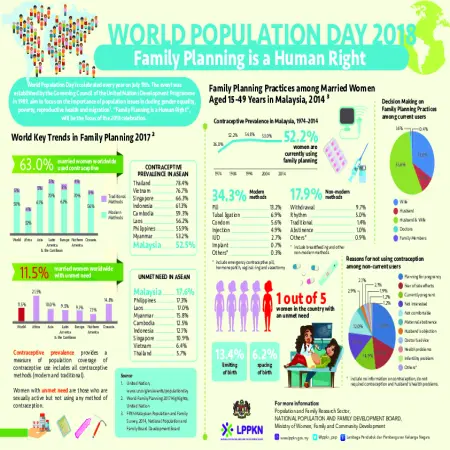
Family planning is a human right
Item Type: Infographic
Editor:
Year: 00/07/2018
Abstract: World Population Day is celebrated every year on July 11th. The event was established by the Governing Council of the United Nations Development Programme in 1989, aim to focus on the importance of population issues including gender equality, poverty, reproductive health and migration. Family Planning is a Human Right, will be the focus of the 2018 celebration.
|
|
|
|
|