Browse by Type
|
Amalan perancangan keluarga di Malaysia: cabaran dan hala tuju
Item Type: Conference or Workshop Item
Editor:
Year: 00/00/2018
Abstract: Family planning allows people to attain their desired number of children and determine the spacing of pregnancies. It is achived through use of contraceptive method and the treatment of infertility. Proportion of women of reproductive aged 15-49 years who have their need for family planning satisfied with modern methods.
|
|
|
|
|
|
Peranan sosialisasi ibu atau bapa komuter dipermudahkan dengan bantuan teknologi gajet dan media sosial: kajian kes di bangunan Ibu Pejabat LPPKN
Item Type: Thesis
Editor:
Year: 00/00/2018
Abstract: This study looks into the role of parents as the socialisation agent for their children in the lives of commuter families, which refers to the parents who do not live with their children due to distance and occupational demands. The rapid development of gadgets and social media technology such as the development of smart phones and
web 2.0 has allowed online social interactions made possible and can be used as a medium of change in being able to connect people who are at a distance from each other as seen in the case of commuter children and their parents. This study looks closely at how gadgets and social media technology helps parents of commuter families who work specifically at the LPPKN headquarters building and the role it plays
as a socialisation agent for their children. There are three research objectives in this study and they are as follows i) to explore the usage of gadgets and social media technology by parents in commuter families, ii) to identify the parenting style that is practiced by parents in commuter families when interacting with their children, iii) to analyse the effects of gadgets and social media technology on the role of parents in commuter families as the socialisation agent for their children. This study uses the qualitative approach through in-depth interviews and non-participant observation there are 10 participants involved in this study that was selected using purposive sampling. The symbolic interactionism and dramaturgy theory was used to explain the role of
gadgets and social media technology to the parents of commuter families and in helping them to understand their role in the socialisation of their children. Results from the study has shown that the use of gadgets and social media technology has definitely aided parents in commuter families' role in being the socialisation agent for their
children through online interactions. Other results include gaining insight to the authoritative parenting style that is executed in a democratic nature of commuter family parents and their consciousness towards the needs of their children. Besides that, the study has shown that gadgets and social media technology has given a positive effect towards parents of commuter families' role in being the socialisation agent for their children, in that it strengthens the bond and interactions between parent and child. This study has found that the use of gadgets and social media technology has enabled parents of commuter families to exercise their socialisation responsibilities towards their children through means of educating them and instilling moral values.
|
|
|
|
|

|
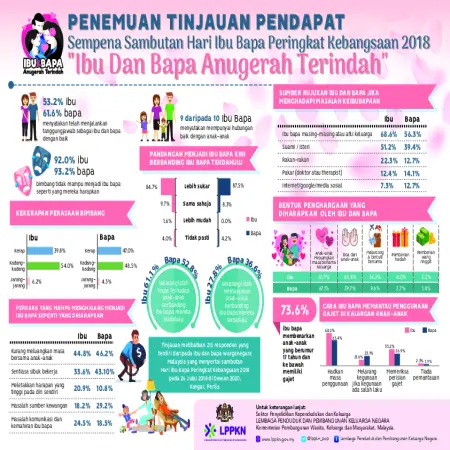
Penemuan tinjauan pendapat sempena sambutan hari ibu bapa peringkat kebangsaan 2018 "Ibu dan bapa anugerah terindah"
Item Type: Infographic
Editor:
Year: 00/00/2018
Abstract: This infographic is about the findings of the opinion poll in conjunction with the 2018 national Parents' days celebration with the theme "Ibu dan bapa anugerah terindah". 9 out of 10 parents state having a good relationship with children.
|
|
|
|
|
|
Parenting style and risk level of drug abuse among students in USIM
Item Type: Thesis
Editor:
Year: 00/00/2018
Abstract: Drug issue is a worldwide problem being faced by many countries and creates a complicated social problem including drug abuse among teenagers. This requires an aggressive corrective action by related agencies because it is getting rampant and has yet to be resolved. Nevertheless, society cannot always depend upon the related agencies to solve this problem. The family institution is believed to also have a role to prevent or reduce the drug abuse rate in teenagers. Looking on this aspect, the parenting style is important in shaping good character in behavior, interest, goals, and beliefs of the teenagers. A total of 121 Tamhidi students in USIM involved as respondents for the present study. Each respondent was given a questionnaire with 60 questions, represented by three sections which are - A: Demography; B: DAST-20; and C: Parenting Style. Results revealed that gender has a significant difference (p<0.05) on sociodemographic characteristic. However, no significant difference (p>0.05) were observed on the age, parent marital status, and family household. On the other part of the study, significant difference (p<0.05) was observed on the parenting style. Authoritarian style of parenting has recorded with a low-risk (46.3%) drug taking by the respondents followed by permissive parenting style (25.0%). The analysis also revealed that respondents with parent who are applying the authoritative parenting style had no-risk of possibility on taking drug (96.7%). In summary, socio-demographic attribute on gender and permissive parenting styles has been associated with high-risk drug abuse among respondents in the present study.
|
|
|
|
|

|
Relationship between family functioning, parenting behaviour, self-efficacy, and gender on risky behaviour amongst adolescents in Kuala Lumpur, Malaysia
Item Type: Thesis
Editor:
Year: 00/00/2018
Abstract: Adolescence is the developmental period marked by a rise in risk-taking behaviours. The high rate of adolescents’ involvement in risky behaviours in the past decades has created a vast amount of attention on the impact to their future. In Malaysia, the impact of risky behaviour has been alarming as evidenced by the media reports on baby dumping, unwanted pregnancies, drug addiction and juvenile delinquency. The increasing trend of adolescents’ involvement in risky behaviour may be associated with social- and self-factors. The current study was conducted to investigate the relationship between family functioning, parenting behaviours, self-efficacy, and gender on risky behaviours amongst adolescents in Kuala Lumpur, Malaysia. This quantitative study utilised a descriptive and correlational research design. Data were collected using self-administered questionnaires. A total of 411 adolescents aged 15 to 18 years were recruited as respondents. Six instruments were used namely the Family Perception Scale, the Parental Monitoring Scale, the General SelfEfficacy Scale, the Adolescent Alcohol and Drug Involvement Scale, the Adolescent Sexual Activity Index, and the Self-Reported Delinquent-Problem Behaviour Frequency Scale to measure the respective variables. Descriptive, bivariate, and multivariate statistics were used in analyses to address the specific objectives of the study. The study found that 12.6% of adolescents reported engagement in substance use, 47.2% in risky sexual behaviour, and 52.1% in delinquency. The independent t-test analysis showed that the proportion of male adolescents who engaged in substance use was higher compared to female. There were no significant differences between male and female in risky sexual behaviour and delinquency. Findings of this study showed that self-efficacy only moderated the relationship between parental monitoring and substance use, whereby the effect is strongest among adolescents with low self-efficacy, and weakest among adolescents with high self-efficacy. This suggested that there is low risky for adolescents to involve in substance use if the adolescent has higher level of self-efficacy. Meanwhile, gender only moderated the relationship between parental monitoring and risky sexual behaviour, whereby the effect is stronger among male adolescents compared to female adolescents. This suggested that male adolescents tend to involve more with risky sexual behaviour compared to female adolescents. The present study conclude that family functioning (family cohesion, communication), parenting behaviour (parental monitoring and parental involvement), self-efficacy and gender influence risky behaviours (substance use, risky sexual behaviour and delinquency) amongst adolescents in Kuala Lumpur. The findings has implication for parents as well as individuals and professional working with adolescents. Parental monitoring was significantly correlated with substance use thus parents were suggested to provide appropriate monitoring to increase awareness that their involvement is crucial in reducing adolescents’ substance use. They also need to be equipped with appropriate skills to establish high quality relationship with their adolescent children. The finding also call for intervention to provide adolescents with necessary skills to help them avoid being involved in risky behaviour.
|
|
|
|
|

|
Laporan fertility at the crossroad-children now, later or never
Item Type: Research Report
Editor:
Year: 00/00/2018
Abstract: This study was to identify the socio-economic and psychological factors that influence the decision of women working in the public and private sectors to want to have children now, postpone pregnancy or do not want to have another child/children. It also to identify forms of support that can be provided by employers in an effort to create a family -friendly work environment. Nowadays, the issue of declining fertility rates is becoming a global issue, not just in among developed countries even in developing countries. Most countries have experienced fertility decline since the 1970s. United Nations Projections (UN) indicates most countries in the Asia Pacific region will experience a decline total fertility rate (TFR) until 2015-2030. Countries like China, Japan and Singapore have achieved TFR below the substitution level for decades ago. Rapid socio -economic development in Malaysia over the past five decades
has resulted in a decrease in births and deaths as well as an increase in migration. Malaysia is currently in the second phase of a demographic transition where fertility rates are increasing decreased while the percentage of the elderly population increased. Decrease in rate
mortality and fertility are closely linked to improved quality of life giving
significant impact on the growth and size of the Malaysian population.
|
|
|
|
|

|
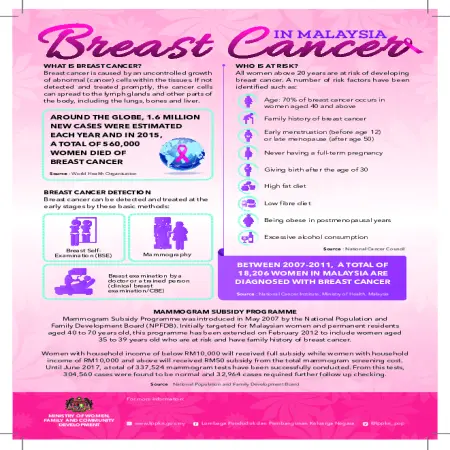
Breast cancer in Malaysia
Item Type: Infographic
Editor:
Year: 00/10/2017
Abstract: The infographic shows the statistic of breast cancer in Malaysia. Breast cancer is caused by an uncontrolled growth of abnormal (cancer) cells within the tissues. If not detected and treated promptly, the cancer cells can spread to the lymph-glands and other parts of the body, including the lungs, bones and liver.
|
|
|
|
|
|
Ajar anak hargai ibu bapa
Item Type: Article
Editor:
Year: 00/07/2017
Abstract: Parents are the most important people in everyone's life. Their service to us is priceless. Ever since we were in the womb, the mother has carried us in her womb for 9 months and 10 days and it is the mother who gave birth to us. Not to be forgotten is also the role of the father who is the leader and takes care of us to the best of our ability. We can show love to our parents by respecting and obeying them. Our parents have instilled pure values in us and educated us since childhood to the best of our ability.
|
|
|
|
|
|
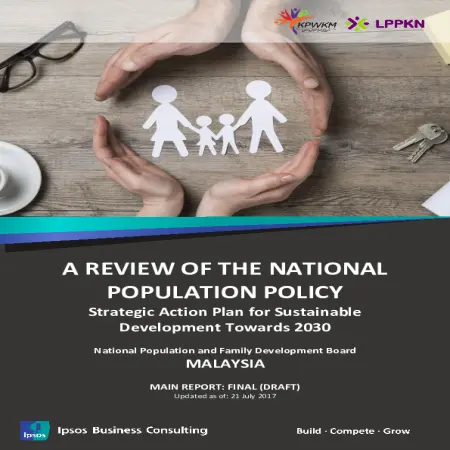
A Review of The National Population Policy : Strategic Action Plan for Sustainable Development Towards 2030.
Item Type: Report
Editor:
Year: 00/07/2017
Abstract: Globalization, technology, and the continuous strive for progress has changed the way people work, live, and build relationships with each other. Across the world, more people are traveling across borders for work, as the world becomes smaller and open markets continue to emerge; people are flocking to the largest cities, creating more pressure on infrastructure, housing and jobs, while also representing social challenges; the rise of the ‘me-culture’ versus the concern and responsibility for the collective ‘family’ is set to continue, while family formation is occurring later and trending towards small-sized norms. Technology, while it has made us all more connected, has made us lonelier as well.
Malaysia is not immune to these global trends. The world is evolving rapidly: new jobs that did not exist before are being created every day, giving rise to an unpredictable future. In order to prepare Malaysians to excel in such an unpredictable future, an effective population policy, updated to best meet the nation’s on-going and future population challenges, needs to be in place.
|
|
|
|
|